
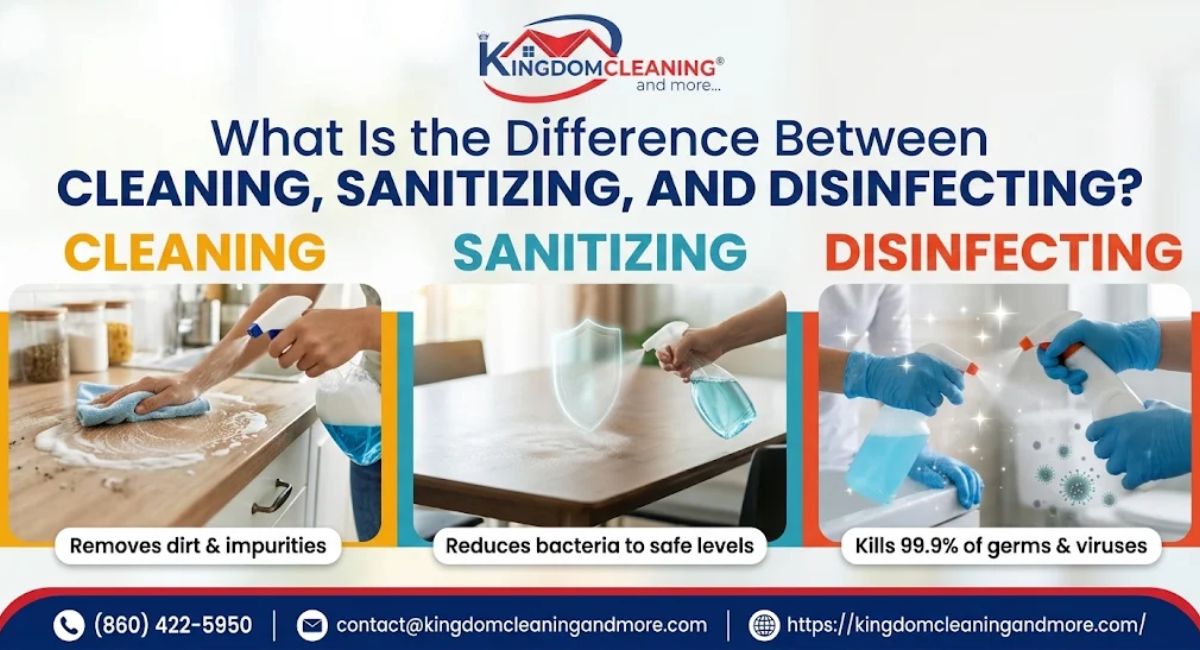
You grab a spray bottle. The label says it kills 99.9 percent of germs. You spritz the counter, wipe it right away, and move on. Did it work?
Probably not as the label intended. And that is not your fault. The words cleaning, sanitizing, and disinfecting get mixed up all the time. Stores sell them side by side. Ads use them as if they mean the same thing. They do not.
Each word describes a different action. Each has a different goal. Each needs a different method. When you know the difference, you save money, protect your surfaces, and avoid using strong products where they are not needed.
This guide explains all three terms in plain English. It shows how products work, how to read a label, and why contact time matters. It also covers where disinfecting makes sense and where simple cleaning is enough.
The Three Terms
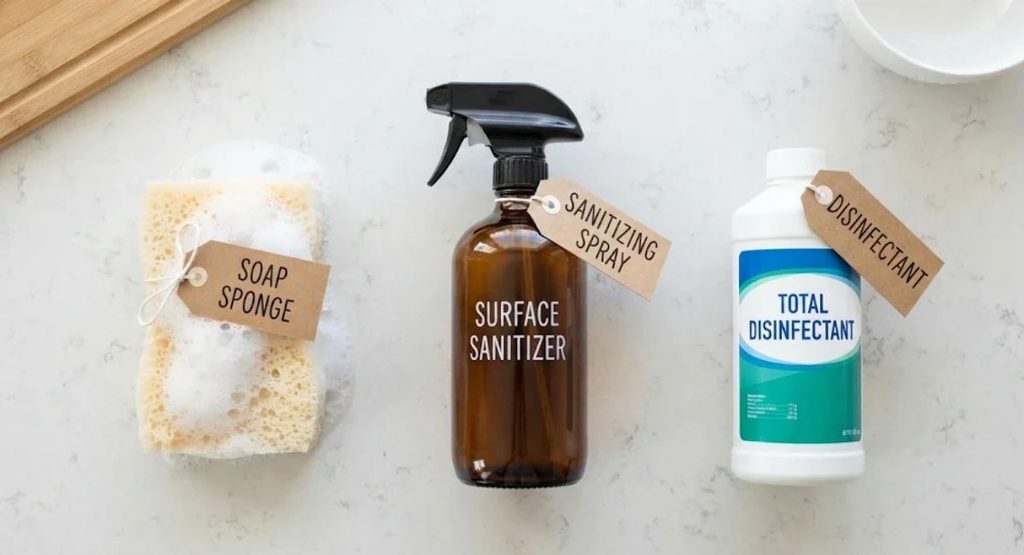
Think of the three terms as three steps on a ladder. Each step does more than the one below it.
Cleaning removes visible dirt, dust, grease, and some germs from a surface. It uses soap or detergent and water. It does not aim to kill germs. It physically lifts them off and rinses them away.
Sanitizing lowers the number of germs on a surface to a level that public health standards consider safe. It does not kill every germ. It cuts the count by a large amount.
Disinfecting kills most germs on a surface. It uses chemicals that are registered for that purpose. It works only if the product stays on the surface long enough.
Here is a simple way to remember them:
- Cleaning removes the dirt.
- Sanitizing reduces the germs.
- Disinfecting kills the germs.
None of these is better than the others. They have different jobs. A kitchen cutting board, a bedroom dresser, and a bathroom toilet each need different levels of care.
Cleaning: The Step That Does Most of the Work
Cleaning is the base of every good routine. It is also the step people skip most often when they reach for a stronger product.
How cleaning works
Soap and detergent have a special structure. One end of each molecule attaches to water. The other end attaches to oil and dirt. Together they break the grip that grime has on a surface. Wiping or scrubbing then lifts it away. Rinsing carries it off.
This process removes many germs along with the dirt. It does not kill them. It simply takes them off the surface. That alone lowers the risk of spreading illness.
What cleaning removes
Cleaning takes care of:
- Dust and hair
- Food crumbs and spills
- Grease and oil film
- Soap scum and mineral spots
- Fingerprints and smudges
It also prepares the surface for any later step. Dirt blocks sanitizers and disinfectants. A layer of grime shields germs from the chemical. A product that cannot reach the surface cannot work.
Cleaning tools that matter
Good tools make cleaning faster:
- Microfiber cloths trap particles instead of pushing them around.
- Dish soap works well for kitchen surfaces.
- All-purpose cleaners handle most counters and tile.
- Scrub brushes and non-scratch pads loosen stuck-on residue.
- A vacuum with a good filter removes dust from floors and upholstery.
Swap cloths often. A dirty cloth spreads soil. Wash microfiber cloths after each use and skip fabric softener, which coats the fibers.
A steady routine keeps surfaces easy to clean. If your week is packed, a cleaning schedule for busy households can help you split tasks into small pieces.
When cleaning is enough
For most daily life, cleaning is enough. Think of a dining table, a bookshelf, a coffee table, or a window sill. These surfaces get dirty. They rarely need a germ-killing product. Soap, water, and a good wipe do the job.
Cleaning is also the right first step when someone is mildly ill, like with a cold. It removes germs without exposing your household to strong chemicals.
Sanitizing: Lowering Germs to a Safer Level
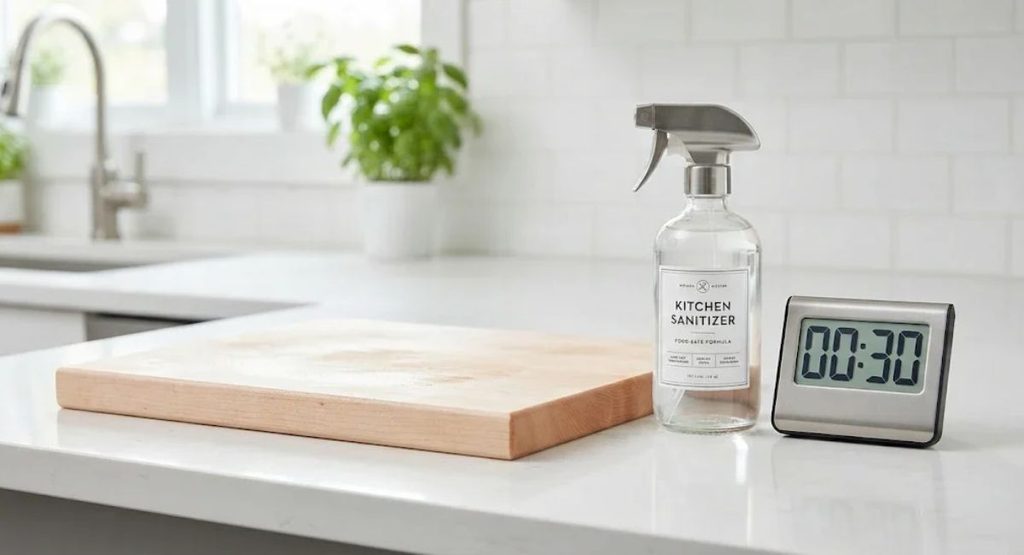
Sanitizing sits between cleaning and disinfecting. It cuts the germ count on a surface. It does not aim to wipe out every germ.
What the term means
In the United States, the Environmental Protection Agency, or EPA, regulates sanitizers and disinfectants as pesticide products. A sanitizer must meet a specific test standard. For non-food surfaces, the claim usually means a large reduction in bacteria within a set time. For food-contact surfaces, the standard is stricter.
You can see the EPA’s resources on registered disinfectants and related products to check how these claims work.
Where sanitizing makes sense
Sanitizing is common in places where food touches surfaces. That includes:
- Cutting boards after raw meat
- Countertops used for food prep
- High chair trays
- Baby bottles and pacifiers
- Pet food and water bowls
- Dishes, when washed with a sanitize cycle
In each case, the goal is to lower germs so the risk of illness drops. You do not need to kill every germ. You need to cut the number to a low level.
Heat as a sanitizer
Sanitizing does not always need chemicals. Heat works well.
A dishwasher with a sanitize cycle uses very hot water to reduce germs on dishes. A washing machine with a hot water setting does the same for towels and sheets. A dryer on high heat adds another layer.
Steam cleaners also reach high temperatures. They can sanitize some hard surfaces, but they must be used correctly and only on surfaces rated for heat. Always check the product guide.
Sanitizing laundry
Laundry sanitizers and oxygen-based boosters can lower germs in fabrics. This helps after illness or with cloth diapers. Follow the label on the product and the care tag on the item. Not every fabric can handle heat or strong additives.
How to sanitize a surface
Here is a basic method:
- Clean the surface first with soap and water.
- Rinse and wipe off the soap.
- Apply the sanitizer as directed on the label.
- Leave it wet for the listed time.
- Let it air dry or follow the rinse instruction if food touches the surface.
Some sanitizers for food-contact surfaces say no rinse is needed. Others do ask for a rinse. The label will tell you.
Disinfecting: Killing Germs on Surfaces
Disinfecting is the strongest of the three. It uses chemicals to kill most bacteria, viruses, and fungi on hard surfaces. It also carries the most rules.
What the term means
A disinfectant is a product that has been tested and registered to kill specific germs on a surface. In the U.S., you can usually spot an EPA registration number on the label. This number shows that the claims on the bottle were reviewed.
A disinfectant does not make a surface sterile. Sterile means free of all life, including spores. Hospitals use sterilization for surgical tools. It is a different level entirely.
How disinfectants work
Different products use different ingredients. Common active ingredients include:
- Quaternary ammonium compounds, often called quats, found in many household sprays and wipes
- Sodium hypochlorite, which is household bleach
- Hydrogen peroxide, found in some cleaners and wipes
- Ethyl or isopropyl alcohol, used in many sprays and wipes
- Citric acid and other acids, found in some newer products
Each one breaks down parts of a germ. Some damage the outer wall. Some disrupt proteins inside. In every case, the germ must be touched by the chemical for long enough.
Where disinfecting makes sense
Disinfecting fits situations where the risk of spreading germs is higher. Examples include:
- Toilets, toilet handles, and bathroom sink handles
- Surfaces after raw meat, poultry, or eggs
- Surfaces touched by someone with a contagious illness like the flu or a stomach bug
- Diaper-changing areas
- Surfaces with bodily fluids, such as vomit or blood
- Commonly shared items in a home with someone who has a weak immune system
In these cases, the extra step has a clear purpose. It lowers the chance that germs will pass from surface to person.
Where disinfecting is not needed
This part matters just as much. Not every surface needs disinfecting. Overuse can cause problems:
- Strong chemicals can irritate skin, eyes, and lungs.
- Some products leave residue that attracts more dirt.
- Harsh formulas can dull stone, wood, and some finishes.
- Constant use may contribute to resistant germs, an issue health agencies continue to study.
A lamp, a bookcase, a bed frame, and a window ledge rarely carry enough germs to justify it. Regular cleaning is usually enough.
This is also why the idea of disinfecting everything daily is not a sound habit. Target the places that carry real risk. Clean everything else.
Cleaning vs Sanitizing vs Disinfecting: A Side-by-Side View
This table sums up the main differences.
| Cleaning | Sanitizing | Disinfecting | |
|---|---|---|---|
| Main goal | Remove dirt and some germs | Lower germs to a safer level | Kill most germs on the surface |
| Uses chemicals? | Soap or detergent | Often, but heat can work | Yes, registered products |
| Kills germs? | Not by design | Reduces them | Kills most listed germs |
| Needs contact time? | No | Yes | Yes |
| Best for | Daily upkeep, dust, spills | Food areas, dishes, baby items | Toilets, raw meat spills, illness |
| Done before the others? | Always first | After cleaning | After cleaning |
The last row is key. Cleaning comes first every time. The other two steps work on a clean surface. They do not work well on a dirty one.
Product Labels: How to Read Them Correctly
Labels hold the answers. Most people skim them. Taking a minute to read them can change how well a product works.
Look for the claim
The front of the bottle shows what the product is meant to do. Look for words such as:
- Cleaner, which removes dirt and soil
- Sanitizer, which lowers germs
- Disinfectant, which kills germs
Some products are two or three in one. A label might say “cleans, sanitizes, and disinfects.” Read the directions to see how to use it for each task. Often the product needs to be applied differently for each one.
Check the EPA registration number
Products that claim to sanitize or disinfect should list an EPA registration number. It is often on the back of the label. If a product makes germ-killing claims and has no number, treat the claims with care.
Read the list of germs
A disinfectant label lists the germs it was tested on. This can include bacteria like Salmonella and Staph, and some viruses. Not every product kills every germ. A label that names the germ you are concerned about is a better choice than one that does not.
Find the surface list
Labels often state which surfaces are safe. Some products should not be used on porous materials like unsealed wood or natural stone. Some are not safe on food-contact surfaces without a rinse. Some can harm fabrics or finishes.
If you are unsure, test on a small hidden area first.
Follow the safety notes
Look for warnings about:
- Ventilation and open windows
- Gloves and eye protection
- Storage away from children and pets
- Products that should never be mixed
This last point is a serious one. Never mix bleach with ammonia. The mix creates toxic gas. Never mix bleach with vinegar or with many acidic cleaners either. If you want to use two products, use them one at a time and rinse the surface between them. Better yet, stick to one product for each task.
Contact Time: The Detail That Makes or Breaks a Disinfectant
Contact time is the single most overlooked part of disinfecting. It is also the reason why a quick spray and wipe often fails.
What contact time means
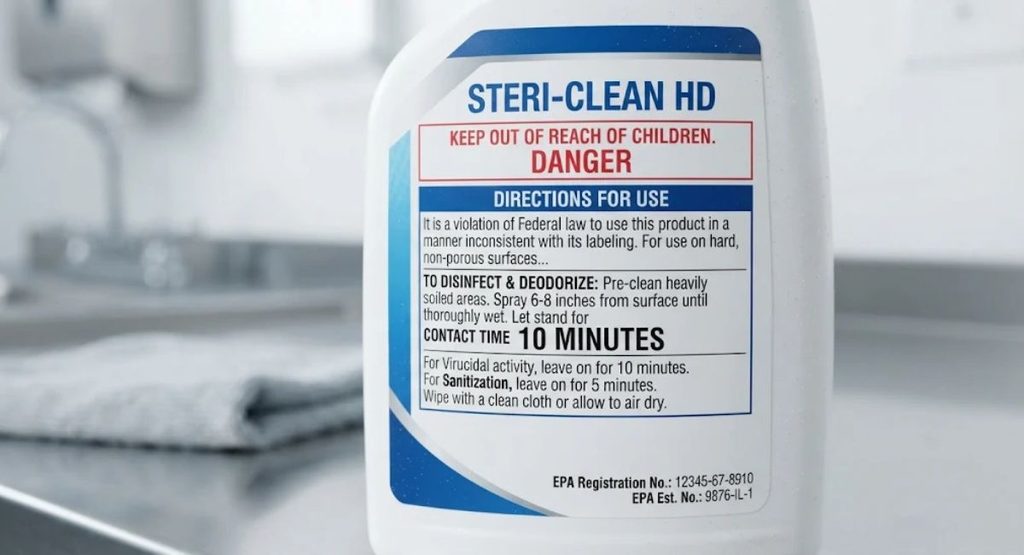
Contact time is the number of minutes a surface must stay visibly wet with the product. During that time, the chemical works on the germs. If the surface dries early, the process stops.
The time on the label is the time used in testing. It can range from 30 seconds to ten minutes, depending on the product and the germ. Many household products fall in the one to ten minute range.
A common mistake
Here is a typical situation. A parent sprays the kitchen counter after prepping chicken. They wipe it dry within five seconds. The counter looks clean. It smells fresh. But the product had no time to work.
The better way is to clean first. Then spray the disinfectant. Leave it wet for the full time on the label. Set a timer if needed. Then wipe or let it air dry as directed.
What to do if the surface dries too fast
Some surfaces dry fast, especially in warm or dry rooms. If the surface dries before the contact time ends, apply more product. Keep it wet for the entire time.
With wipes, use more than one for larger areas. A single wipe will not keep a large surface wet long enough.
Why different germs need different times
Some germs are tougher than others. A product may kill a common bacteria in 30 seconds. It may need ten minutes for a harder virus or fungus. The label may list more than one contact time. Use the time for the germ you are targeting.
If the label lists several times and you are not sure which applies, use the longest listed time. That covers the full range of claims.
How to Disinfect a Surface Step by Step
Here is a reliable method for any disinfecting task:
- Put on gloves. Open a window or turn on a fan.
- Clean first. Wash the surface with soap and water. Remove all visible dirt.
- Rinse and wipe. Remove soap residue, since some soaps can reduce disinfectant strength.
- Apply the disinfectant. Cover the entire surface. Use enough to keep it wet.
- Wait the full contact time. Use a timer.
- Wipe or air dry. Follow the label. Rinse if the surface touches food or skin.
- Wash your hands. Store the product safely.
The process is simple. It just needs patience.
For a deep reset of the home, a professional deep cleaning in Hartford CT covers the cleaning step in places that are often missed, like baseboards, grout lines, and appliance edges. A clean base makes later disinfecting more effective.
Room-by-Room Guide: What to Use Where
Not every room needs the same level of care. Here is a guide for common areas.
Kitchen
The kitchen has the highest mix of risk and need.
- Daily: Clean counters, sink, and stovetop with soap and water.
- After raw meat or eggs: Clean, then sanitize or disinfect the surface, based on the product label.
- Cutting boards: Wash after each use. Sanitize after raw meat. Replace boards with deep cuts, which trap germs.
- Sponges and dish cloths: Replace them often. Wet sponges hold a lot of bacteria. Run cloths through a hot wash.
- Fridge handles and microwave buttons: Clean weekly. Disinfect if someone is ill.
Grease can block the cleaning step. If your stove or hood has a sticky film, see our guide on how to clean sticky cabinet doors. Grease must go before any sanitizer can reach the surface.
Bathroom
Bathrooms are the second area where disinfecting makes good sense.
- Toilet: Clean the bowl and seat. Disinfect the seat, handle, and surrounding area.
- Sink and faucet handles: Clean often. Disinfect when someone is ill.
- Shower and tub: Clean to remove soap scum and body oils. Disinfecting is usually not needed unless mold or a health reason applies.
- Floor near the toilet: Clean weekly. Disinfect as needed.
A word on mold. Mold is a fungus that grows on damp surfaces. Cleaning removes surface mold. A product labeled for mold may help with small spots. Large areas or repeated mold growth point to a moisture problem that needs a fix at the source.
Bedrooms and living areas
These rooms need regular cleaning. Dust, dander, and fabric fibers are the main issue.
- Vacuum floors and upholstery.
- Wipe hard surfaces with a damp microfiber cloth.
- Wash bedding weekly in hot water if the care label allows.
- Disinfect only the high-touch items if someone is sick, such as remote controls, light switches, and door handles.
Dust can build fast if the source is not controlled. Our article on why your house gets dusty so quickly explains the common causes and fixes.
Entryway and high-touch spots
Doorknobs, light switches, handrails, and phones pick up germs through daily use. A weekly wipe with a standard cleaner is a sound baseline. During cold and flu season or when someone is ill, a disinfecting step on these spots makes sense.
Children’s rooms and play areas
Toys that go into the mouth need washing. Hard plastic toys can go through the dishwasher or be washed in hot soapy water. Soft toys can go in the washing machine. Wipe play mats with a mild cleaner. Choose products labeled safe for children’s items if you need to sanitize.
Special Surfaces and Materials
The right product depends on the material. Using the wrong one can damage the finish or reduce the product’s effect.
Hard, non-porous surfaces
Glass, sealed tile, stainless steel, laminate, and plastic handle most products well. They are the easiest surfaces to sanitize and disinfect.
Porous and delicate surfaces
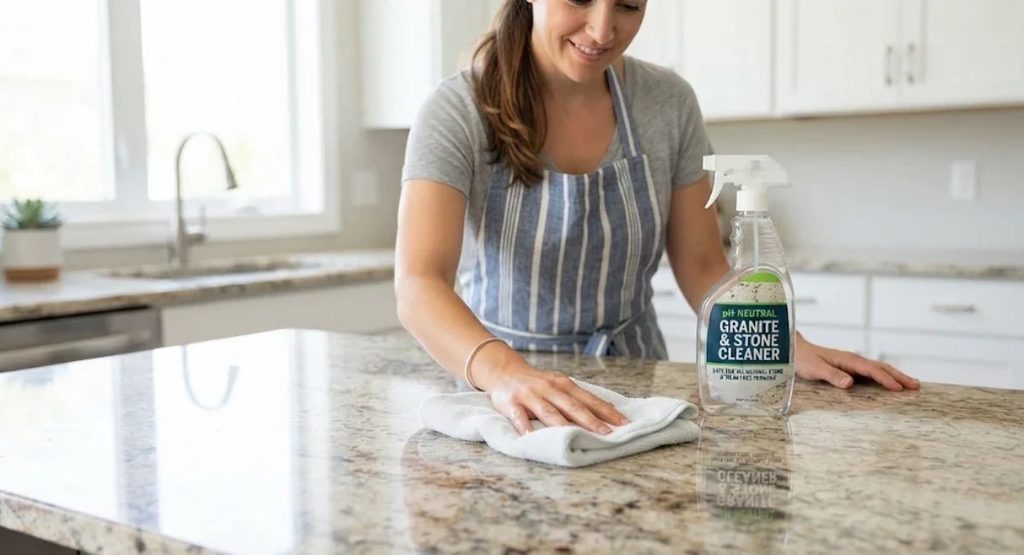
Unsealed wood, natural stone like marble and granite, and grout can be damaged by harsh chemicals. Acidic cleaners can etch stone. Bleach can discolor wood. Use pH-neutral cleaners on stone. Check care guides for sealed wood floors.
Electronics
Phones, tablets, and remotes need gentle care. Use a soft cloth with a small amount of isopropyl alcohol or an approved wipe. Do not spray directly on the device. Check the maker’s guidance. Many brands publish care steps on their support pages.
Soft surfaces
Carpets, couches, and curtains cannot be disinfected the way hard surfaces can. Clean them by vacuuming and spot cleaning. Wash what you can in the machine. Some steam cleaners are rated for soft surfaces. Check the label first.
Food-contact surfaces
This includes cutting boards, high chair trays, and dishes. Any sanitizer or disinfectant used here must be labeled safe for food-contact surfaces, or must be rinsed off after use. Read the label closely.
When a Stomach Bug Hits the Household
Here is a case that shows how all three steps work together.
A family of four has a stomach bug going around. One child threw up in the bathroom. The parent wants to stop the spread.
They start by putting on gloves and opening a window. They remove visible waste with paper towels and bag it. Then they clean the area with soap and water. That is the cleaning step.
Next, they choose a disinfectant that lists norovirus on the label. Norovirus is a common cause of stomach illness, and it is harder to kill than many germs. They read the contact time, which is several minutes. They spray the area and leave it wet for the full time.
After that, they wipe the area and let it dry. They wash the child’s bedding and clothes on a hot cycle. They disinfect the toilet handle, sink faucet, and door handle. They wash their hands with soap and water, since hand sanitizer is less effective against norovirus.
The next day, they do not disinfect every room. They keep up regular cleaning. They target only the surfaces that the sick child touched.
This plan is focused. It uses stronger steps where they matter. It avoids unneeded exposure in other rooms.
Common Mistakes That Reduce Results
Even careful people make these errors. Fixing them can improve results fast.
- Skipping the cleaning step. Dirt blocks the product from reaching germs.
- Wiping too soon. The product needs its full contact time.
- Using too little product. The surface must stay wet.
- Mixing products. This can create dangerous fumes.
- Using a dirty cloth. It moves germs from one place to another.
- Assuming natural means disinfecting. Vinegar, baking soda, and essential oils can help with cleaning. They are not registered disinfectants.
- Using disinfectant on everything. It adds exposure and cost with little benefit.
- Ignoring the surface type. Some products can harm finishes.
A note on vinegar. It works as a mild cleaner on glass and some hard surfaces. It can cut mineral spots. But it is not a registered disinfectant. If you want to remove mineral stains from glass, see our guide on removing hard water stains from glass shower doors.
Hand Hygiene and Laundry: Related Questions
People often ask how these terms apply to hands and clothing.
Hands
Hands are not treated like surfaces. The best method is washing with soap and water for about twenty seconds. That removes germs and dirt. Alcohol-based hand sanitizer helps when soap is not available, as long as it contains enough alcohol and hands are not visibly dirty. Do not use household disinfectants on skin.
Laundry
Most laundry needs only a regular wash. Hot water and a hot dry cycle add a sanitizing effect. If someone is ill, wash their bedding and towels separately on the warmest setting the fabric allows. Wear gloves when handling soiled items. Wash your hands after.
Eco-Friendly and Low-Chemical Choices
Many households want to reduce chemical use. That is a fair goal. It fits well with the idea that not every surface needs disinfecting.
Simple steps can help:
- Do most daily work with soap, water, and microfiber.
- Use heat when possible, like hot laundry cycles and dishwasher sanitize settings.
- Keep disinfectants for high-risk moments.
- Choose products with clear labels and EPA numbers.
- Ventilate the space during use.
Some disinfectants use hydrogen peroxide or citric acid. These break down into simpler compounds and may have lower odor. They still need contact time. They still need to be used on a clean surface.
When Professional Cleaning Helps
A home routine covers most needs. Some situations are better with outside help.
Consider professional help when:
- You are recovering from illness and want a thorough reset
- You are preparing for a new baby or a guest with health needs
- Heavy buildup makes cleaning hard
- You are moving in or out
- Your schedule leaves no time for steady upkeep
A trained team can complete the cleaning step well. They know the right tools for each surface. They also know which areas need extra care and which do not.
If you are moving, a move-in and move-out cleaning removes old grime from cabinets, appliances, and bathrooms so you start with a clean space.
For steady upkeep, recurring cleaning plans in Connecticut and MA keep surfaces under control, so each visit stays focused on what the home needs.
Frequently Asked Questions
Is sanitizing the same as disinfecting?
No. Sanitizing lowers germs to a safer level. Disinfecting kills most germs listed on the label. Disinfecting uses stronger standards and often needs a longer contact time.
Do I need to disinfect my whole house?
No. Most surfaces only need regular cleaning. Disinfecting makes sense in specific cases, like toilets, raw meat spills, or when someone is ill.
Can I use vinegar to disinfect?
Vinegar is a mild cleaner. It is not a registered disinfectant. It will not replace a product with an EPA number when disinfecting is needed.
What is the right contact time?
The contact time is on the product label. It ranges from under a minute to ten minutes. Keep the surface wet for the full time.
Do I clean before I disinfect?
Yes. Dirt can block the product and weaken the result. Always clean first.
Can bleach and other cleaners be mixed?
No. Never mix bleach with ammonia, vinegar, or acidic cleaners. The mix can release toxic gas. Use one product at a time and rinse between them.
Does a product that says 99.9 percent mean it kills all germs?
No. The claim applies to specific germs and test conditions on the label. It does not cover every germ on every surface.
Do I need to disinfect after cleaning every day?
No. Daily disinfecting is not needed in a typical home. Use it when there is a reason, such as illness or raw food contact.
Match the Step to the Situation
Cleaning, sanitizing, and disinfecting each have a role. Cleaning removes dirt and lifts germs. Sanitizing lowers germs to a safer level. Disinfecting kills most germs on a surface, and only when the product has enough contact time.
Most of your home needs plain cleaning. Food areas often need sanitizing. A few spots, like toilets and surfaces after illness, call for disinfecting. Read the label. Clean first. Give the product its full time. Skip the rest.
This approach saves money, protects your surfaces, and reduces needless chemical exposure. It also gives you better results.
If you want help building a cleaner home without the guesswork, Kingdom Cleaning and More is ready to help. Our team offers residential cleaning, deep cleaning, and recurring plans built around how your household really lives. Visit our residential cleaning in West Hartford CT page to book a visit and get your home to a clean, comfortable baseline.
Leave a Reply